Indy, but bigger

When I got home after a day spent at the National Eucharistic Congress last week, it dawned on me this was the second time I had attended Mass in Indianapolis. The two experiences could not have been more different.

This past week, I was joined by at least 20,000 other Catholics celebrating joyously in the makeshift worship space of Lucas Oil Stadium. The giant arena was transformed into a fitting place to praise God.

The Mass was led by Cardinal Timothy Dolan of New York, backed by several dozen other bishops and archbishops. Below, more than a hundred priests were on hand to dispense the Eucharist throughout the stadium, while men and women religious and seminarians sat behind them. The entire thing was a sight unlike any other.

But as I reflected, I recalled the previous time I worshiped in the Capital City. It was almost three years earlier, in the tiny non-denominational chapel at Methodist Hospital. Upstairs, my wonderful mother-in-law was living her final days, and I joined the sacristan as the sole parishioners taking part in the daily Mass that day.

Yet, whether surrounded by thousands of celebratory Catholics, or painfully praying for the soul of my beloved family member, in both places Jesus was present. In the Eucharist. As He is every time Mass is said, all over the world.

It is a comforting thought, and one that reminds us of the blessing available to us each and every day in our Church.

Rest in Peace, Father Norman

I was deeply saddened to learn today of the sudden passing of Father Norman Fischer of St. Peter Claver in Lexington, Ky. Father Norman invited me to visit the parish in 2022 to attend Mass with both the neighborhood parishioners as well as the Congolese Catholic Community.

I returned to St. Peter Claver this spring to see the new worship space, which Father Norman helped oversee.

Eternal rest grant unto him, O Lord, and let perpetual light shine upon him.

May his soul and the souls of all the faithful departed, through the mercy of God, rest in peace. Amen.

The Other Notre Dame

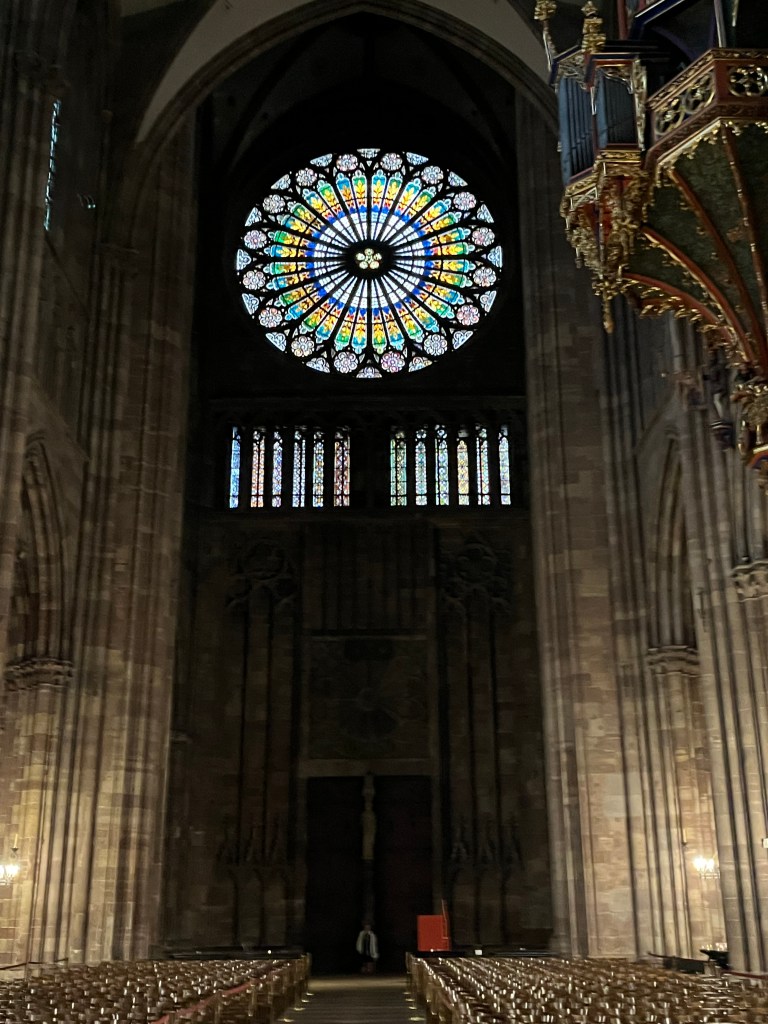
We move on to Strasbourg, the heart of Alsace. And the heart of Strasbourg is the Cathedral of Notre Dame de Strasbourg.

Though not as well-known as the other Notre Dame in France, the seat of the Archdiocese of Strasbourg is a marvel in its own right, one of the finest examples of Rayonnant Gothic architecture, if the kids at Wikipedia are correct. No less an expert than Victor Hugo described it as “a skillful combination of monumental size and delicateness.” 

Ground was broken on the cathedral in 1015, but it was only completed more than four hundred years later. It extends more than 460 feet above the city, which made it the world’s tallest building from 1647 to 1874. 

Home of a Saint

Still in Eguisheim. The tiny village has not just given us Saints Pierre-et-Paul and the inspiration for Beauty and the Beast. It also gave us a saint.

Bruno von Eguisheim-Dagsburg was born in Eguisheim in June 1002. In 1949, he was chosen to head the Catholic Church, becoming Pope Leo IX. “As pope, Leo expanded his work of reform to the entire church. Not only did he work to fight simony (the buying and selling of church offices) and imposing clerical celibacy, he also promoted the education of the clergy and liturgical reforms,” Aleteia describes.

His papacy lasted until his death in 1054.  A mere 28 years later he was canonized by Pope Gregory VII. His feast day is April 19, the date of his death.

He is celebrated with a sculpture in the heart of Eguisheim, beneath the Chapelle Saint Leon IX (here, he’s more commonly referred to as Leon). Pictured is the statue of Saint Pope Leo IX, and another shot of my wife and I in front of it (taken by our helpful tour guide, Robin).

Exquisite Eguisheim

Of all the places I visited in France, my favorite might have been the tiny medieval village of Eguisheim.

Today, we focus on Saints Pierre-et-Paul Church. As is the case in many French villages in the Alsace, Saints Pierre-et-Paul towers over the town. Here, that makes it the perfect spot for storks to nest, as you can see from one of the photos.

But the most inspiring sight here was the vierge ouvrante, or Opening Virgin, a specific type of statue of Mary unique to France, Germany and Spain between the 13th and 16th centuries. As described by Aleteia, “during most of the year, they looked like ‘regular’ statuettes, made of wood and ivory. But on certain occasions, such as Marian or Trinitarian festivities, they would be opened, revealing a work of art within the work of art.”

At Saints Pierre-et-Paul, the Opening Virgin is a polychrome wood sculpture. It’s permanently half-opened revealing some of the art inside. I can’t quite explain why, but it’s easily one of the most mesmerizing pieces of religious artwork I’ve ever seen.