Painful Reminders

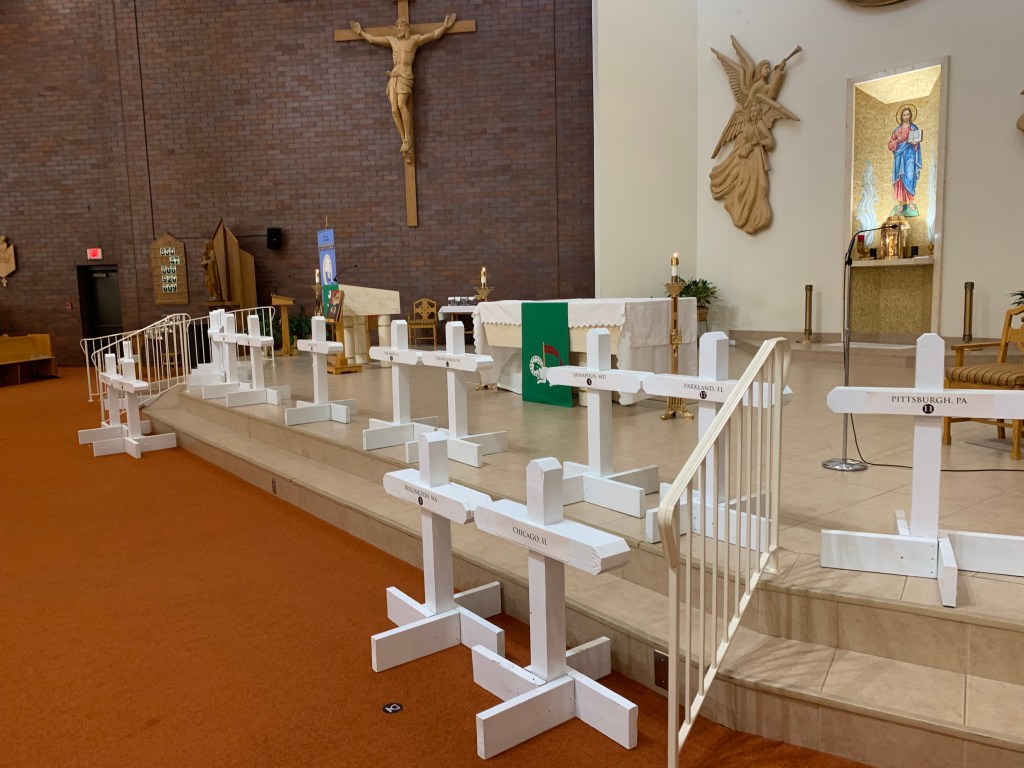
Visitors to Nativity of Our Savior, my home parish in Portage, Ind., were greeted with an unusual sight last weekend. The steps to the altar were lined with white crosses, similar to what you’d find in military graveyards.

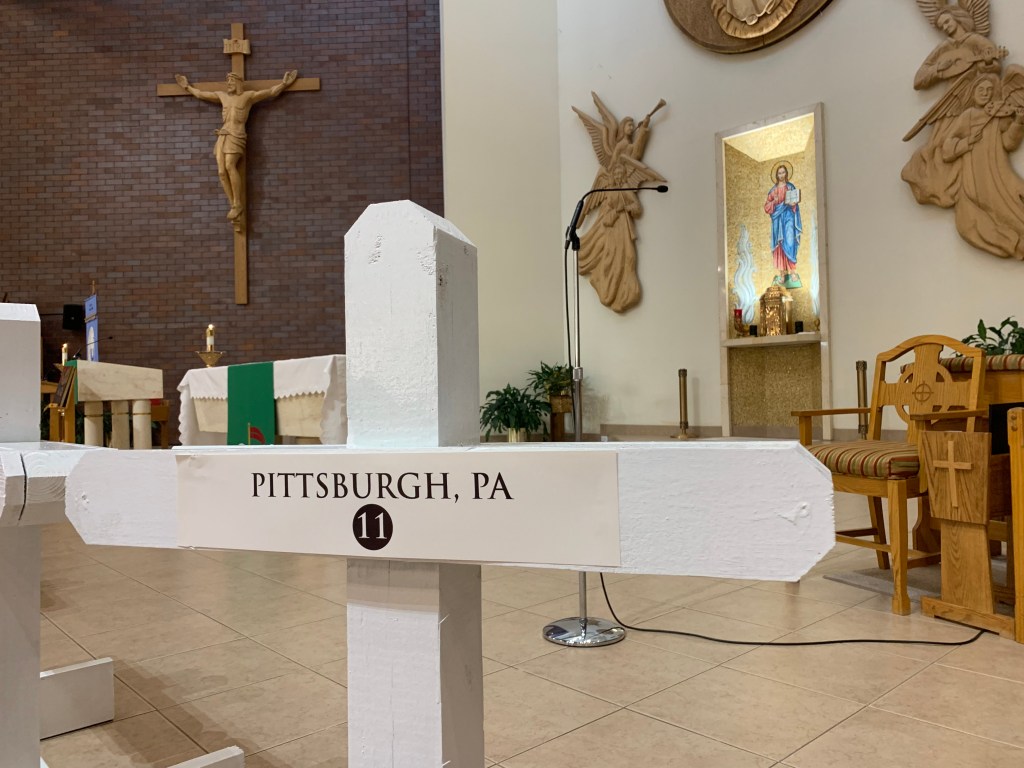
Closer inspection showed each of the crosses bore the name of a city that had been the victim of mass shootings. Two additional crosses were there for nearby Gary and Chicago, which has avoided mass shootings but suffer gun-related homicides with all-too-much frequency.

It was a powerful image, and a sobering reminder of the pain that’s inflicted on communities almost daily, whether that’s in a single-shooter event, or those lives lost just one at a time.

I don’t know the answer to the scourge of gun violence. Nor do I imagine that Father Kevin McCarthy does either. But it is a subject that demands our attention, and hopefully that vigilant attention and concern can help in the pursuit of a solution.

The steps to the altar at Nativity of Our Savior Parish in Portage.

A cross identifying the 11 killed at Tree of Life Synagogue in Pittsburgh in 2018, one of several mass shootings to occur in places of worship.

Christ, You Have Spoken to Us of Children

Saturday brought my wife and to Hamilton, Ohio, as we once engaged in our regular game of “Where are we going to live next year?” The city of 62,000 sits north of Cincinnati on the Whitewater River.

After driving around town, and somewhat limited in our ability to traipse by foot, we found ourselves with time to kill. Thus, it was quite lucky to discover Mass was about to begin at St. Julie Billiart, located just across the street from the unfortunately spelled Marcum Park. St. Julie’s was a gorgeous facility, but it was the opening song that made the biggest impression on me.

The song was a Polish carol titled Zlobie Lezy, or Infant Holy, Infant Lowly. But it wasn’t that version sung on Saturday. This version went like this:

Christ you spoke to us of children: “Let the children come to me
Do not stop them, for the kingdom is for little ones like these
God we grieve now as our nation falls its moral obligation to receive the refugees

I looked down, and sure enough, the lyrics were written in 2019, by Caroly Winfrey Gillette. This was not a song that just happened to match our world today, but was clearly written in response to the ongoing situation on the border.

I was surprised, and impressed. Regardless where one stands on immigration, there should be no dispute among Catholics about the treatment of the children in our care by our government. Jesus’s teachings on the subject of how we as Christians should treat the stranger, the refugee, the immigrant, are unmistakable. I was glad to see St. Julie Billiart and Father Robert Muhelenkamp unafraid to affirm that.

A few hours before we gathered for Mass, 20 people in El Paso were killed in one of the deadliest shootings in American history. By all appearances, the killer was motivated by anti-immigrant views.

As a country, we have to be better. And as Catholics following the words of Christ, we ought to lead the way.

American Heroes

As noted here a few weeks back, late May took me to Baltimore to see my oldest son’s graduation from college. Though I flew in, I made the 10-plus hour drive home in his car.

Since I started traveling to Charm City back in 2014, I’ve long wanted to stop at one of the most notable places along the way – the Flight 93 Memorial in Central Pennsylvania. This was my last chance, and I wasn’t going to pass it up.

The Memorial marks the spot on Sept. 11, 2001, where the last of four hijacked commercial airlines plunged into the ground, killing all aboard. It was the final tragedy on the most horrific morning most of us will ever experience.

I share my visit in this space because I think the passengers on Flight 93 acted in about the most Christ-like fashion of any people I can recall. We often talk about those who put their lives on the line for us – police officers, firefighters and military personnel, among them. And those individuals deserve our full respect. But most of them fully expect, or at least hope, to come home safely at day’s end.

That wasn’t an option for the passengers on Flight 93. By choosing to rush the cockpit and challenge the hijackers, they saved a great many lines at the absolute expense of their own. They died for us.

Today seems like a fitting day to salute them.

The 1/4 mile walkway marks the edge of the debris field.
The 17-ton boulder represents the approximate location of the point of impact.
The Wall of Names. Though individual slabs, they appear to be a solid wall, reflecting the unified teamwork of the passengers and crew onboard.

Catholic Baltimore

For the final time, at least until my trip in 2021, I visited Baltimore last week. The occasion was my oldest child’s graduation from Johns Hopkins University. Needless to say, I’m a little proud of the young man, even if my role in his acceptance into and degree from one of the country’s finest institutions was quite limited.

I spent three days in the city, allowing me to do a little more sightseeing than most of my quick drop-offs/pickups over the last 5 years. And for a Catholic, there are many, many worse places to find yourself in than Charm City.

In many ways, Baltimore is the country’s original Catholic city (with apologies to St. Augustine, Fla.), given its importance in Maryland, a place where Catholics found a home in the overwhelmingly Protestant fellow 12 colonies. The colony was founded by Catholic convert George Calvert, who sought to create an area where people could be free to worship as they pleased.

Catholicism has flourished in Baltimore, and continues to do so.

My first stop, shortly after reconnecting with my son at his current place of work, was the Basilica of the National Shrine of the Assumption of the Blessed Virgin Mary. It is America’s first Cathedral, built by famed architect Benjamin Henry Latrobe and home to America’s first bishop, John Carroll. It was the funeral site for Charles Carroll, the only Catholic signer of the Declaration of Independence. Most of the early bishops were consecrated here. Few churches in this country match its place in Catholic history.

The Ascension of Our Lord depicted on the East Saucer Dome at the Basilica.
The altar at the National Shrine of the Assumption of the Blessed Virgin Mary.
This painting was given to the archdiocese by French King Louis XVIII.
A look at the Basilica from the corner of Cathedral and Wilson streets.

Sitting one block up and one block east of the Cathedral is the Pope John Paul II Prayer Garden, a tiny spot of green to commemorate his visit to the city in 1995. The garden contains a lovely statue of the pope and two small children,  based on a photo taken when the pope arrived at BWI Airport. It also features a quote from his visit highlighting the importance of religious freedom, harkening back to the colony’s founding. It’s a lovely tranquil place in an otherwise busy neighborhood.

The Pope John Paul II Prayer Garden.

By happy coincidence, the hotel my wife chose to stay in, a few blocks northeast of Baltimore’s Inner Harbor, was also just across the street from the National Shrine of St. Alphonsus Liguori. On Graduation Day, I woke up early to attend Mass at the beautiful church, once home to St. John Neumann. It was my first Latin Mass, though it’s possible I attended some when I was a very small child.

A look at the church from my hotel window. And if it looks surprisingly clear, that’s because my hotel window surprisingly opened.
There were about a dozen of us worshiping at the 7 a.m., Tridentine Mass. This was taken after Mass had ended.
The Gothic Revival style church was absolutely stunning, particularly when the lights were dimmed.

Finally, as we were making our final preparations before the four-hour commencement exercise at Royal Farms Arena, I sneaked off to the St. Jude Shrine. The “Forgotten Saint” or the patron saint of lost causes, Judas Thaddeus has been celebrated here since 1917, when the Nationwide Center of St. Jude Devotions was founded by the Pallottines. As with the Basilica, there was a steady stream of guests dropping in to pray that afternoon.

Two perpetual Novena services are held every Wednesday, three are conducted on Sundays and the Shrine hosts three Solemn Novena services annually.
The Shrine, founded in 1917, originally attracted just local folks, but now requests for intercessions from St. Jude come from all over the world.

Link worthy

This would have made an outstanding entry in 52 Masses. Alas, the good folks at America: The Jesuit Review beat me to it.

On Memorial Day, this is a wonderful tribute to our fallen servicemen and women. God bless them all, and thank you to these young men at Catholic Memorial for how they honor them. See the story here.